


“I have plenty of dashboards. Why do I still need three people to explain what’s happening in my business?”
That question stayed with us because it was not really a complaint about dashboards. It was a complaint about distance. The founder could see the numbers, but the meaning still arrived second-hand—assembled across a product review, a growth meeting, an analytics exploration, and several people carrying different parts of the story.
The marketing team could explain where attention came from. The product team could explain which features people used. Engineering could explain the instrumentation. Each view was useful. Yet the person accountable for the whole business was still asking a very human question: what actually happened, and where should I look next?
That is why we are building Presagio.
Field signal/ 01We’re building Presagio so founders can see how attention becomes intent, understand where progress stalls, and follow the evidence themselves.
The gap between data and understanding
Most digital businesses are not short of data. A typical day produces page views, campaign clicks, form starts, account events, feature activity, return visits, and dozens of operational measures. Modern analytics tools are remarkably capable of collecting and exploring that activity.
The difficulty begins when those measurements need to become one coherent account of a customer journey. A campaign visit may sit in one report. A meaningful article read may be another event. A product page visit appears elsewhere. A form start looks promising, while a completed submission lives in a different system entirely.
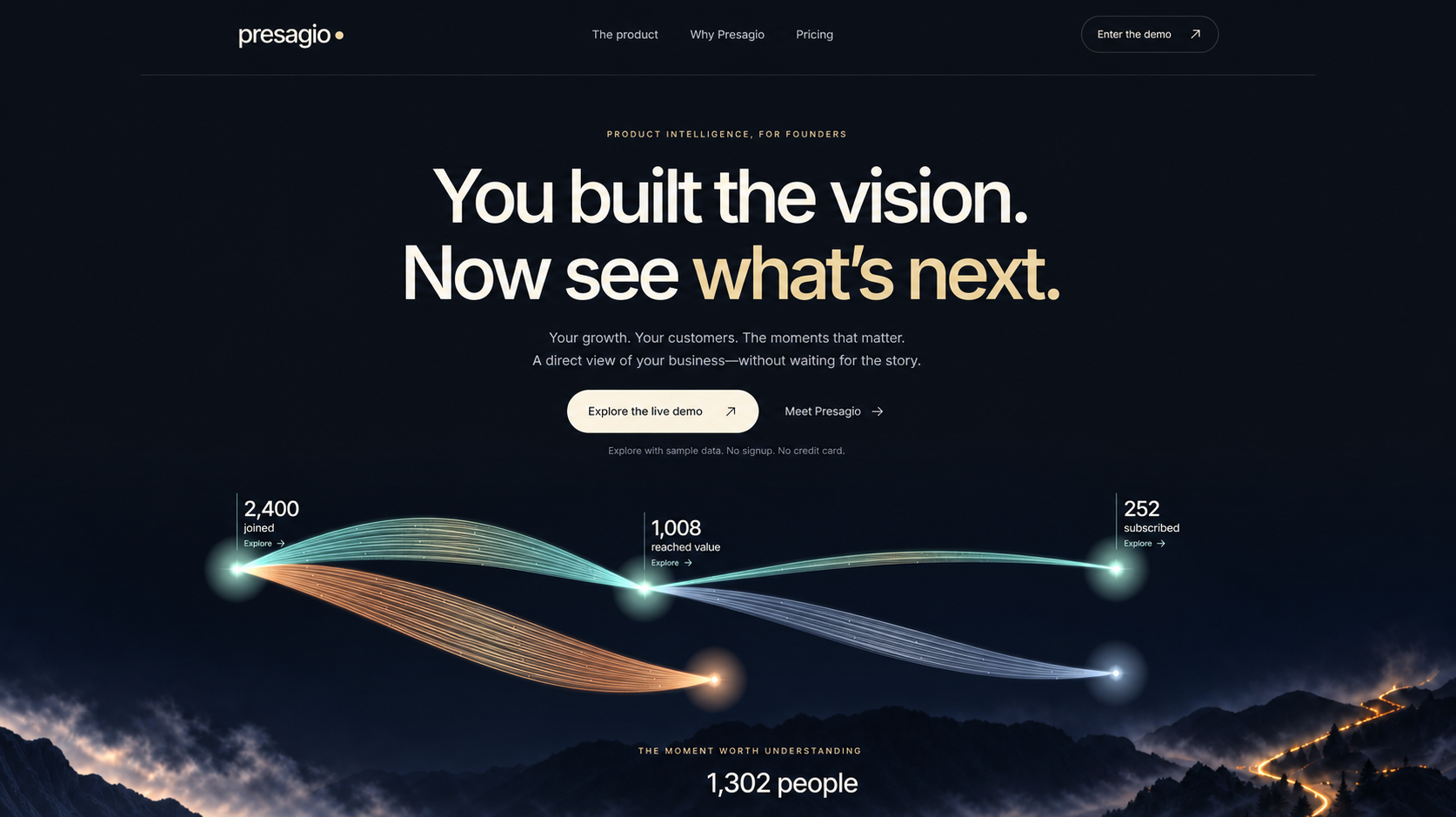
None of those numbers is the story by itself. The story is the movement between them: which attention deepened into curiosity, which curiosity became intent, and where momentum faded before the next meaningful step.
The founder should be able to follow that movement without first translating the question into analytics syntax or waiting for three departments to reconcile their views.
Start with the question, not the event stream
We designed Presagio from the question backward. A founder rarely begins the morning by asking for an event table. The questions sound more like this: Are we growing? Are people reaching value? Where are customers struggling? What changed? What deserves investigation now?
That changes the shape of the product. Presagio begins with an outcome and a journey. It shows the moment that moved, then makes the gap visible. From there, the founder can move closer—to the qualifying people, the sequence of observed moments, and the session evidence available behind them.
- The useful sequence is deliberately simple:
- See what changed.
- Follow the journey.
- Open the moment where progress stalled.
- Inspect the evidence before deciding what it means.
Presagio is not trying to eliminate analysis. It is trying to make the path into analysis legible—so the first conversation begins with a shared observation instead of a debate over which dashboard is correct.
Why the name Presagio
The name began with presage: an indication of what may come next. We liked its sense of looking forward, because every founder is building toward a future that does not exist yet. But the product is not a fortune teller, and we did not want the name to promise certainty that the evidence cannot support.
Presagio is our twist on that word. It keeps the forward-looking instinct but gives it a different cadence—warmer, more human, and distinctly its own. The final dot in the wordmark matters too. It turns the name from an open-ended prediction into a clear statement: begin with what is known, then look ahead with better judgment.

A signal can suggest where to look. It cannot tell you, with absolute certainty, what will happen. That boundary is not a limitation we hide; it is part of the product’s character.
Field signal/ 02The name looks toward what comes next. The product stays accountable to what the evidence can actually say.
Beautiful enough to invite investigation
The luminous paths in Presagio were not added after the product was designed. They are the product idea made visible. A customer journey is not a pile of isolated bars; it is movement. Some paths continue. Some divide. Some disappear before reaching the next moment of value.
We wanted the experience to feel expansive enough for a founder to pause and look. The mountain horizon creates a sense of distance and possibility. The moving lines give the eye a path to follow. The gap becomes a place, not merely a percentage.
But beauty has to earn its place. Every visual path must lead back to a count, a definition, a cohort, or a session. If the graphic creates drama without making the investigation clearer, it has failed. Presagio should feel cinematic at first glance and rigorous at the next click.
Definitions are part of the interface
The most dangerous analytics mistakes are often linguistic. A number is given a confident label, the label travels into a meeting, and an assumption quietly becomes a fact.
A form start is not a lead. A browser request accepted by a server is not automatically a successful business outcome. A person who has not yet reached the next step may still be on the way there. A campaign can receive attribution credit without proving that it caused the conversion.
Presagio treats those distinctions as product design, not documentation. A meaningful moment needs a visible definition. The conditions should be inspectable. When the business learns and the definition changes, that history should remain traceable rather than silently rewriting the past.
This is also why the platform allows teams to begin with deliberate events and shape business moments around them. The event is an observation. The definition gives it meaning. The journey shows its relationship to other moments. The evidence keeps the conclusion honest.

What the first TDG implementation taught us
The Dev Guys became one of the first real properties we instrumented with Presagio. That was intentional. Before asking another team to trust the product, we wanted it to confront the ambiguity inside our own website.
We defined 24 deliberate events and six journeys across the experience. They cover page visits, meaningful article reading, service exploration, product discovery, outbound product visits, project-dialog engagement, and the moments that indicate a genuine attempt to start a conversation.
The implementation is consent-aware. It does not treat a page load as permission, and it avoids collecting the values people type into forms. Just as importantly, the names describe what was actually observed. We can know that a visitor opened the project dialog or attempted a valid submission; we should not quietly upgrade that into a sales-qualified opportunity.
That work made the promise more concrete, but it also exposed the less glamorous foundation a serious analytics product needs: dependable ingestion, clear identity and session rules, campaign context, retention controls, and the ordinary traffic views people reasonably expect.
Twenty-four definitions and six journeys are not a traction claim. They are the measurement language now in place for learning what happens next. Presagio’s public demo uses fictional sample data and simulated replay, and the browser integration remains in private beta; those demonstrations remain clearly separate from the live, consent-aware TDG integration.
One clearer view
We do not believe founders need fewer facts. We believe they need less distance between a fact and the journey that gives it meaning.
Presagio is our attempt to close that distance: to begin with the business outcome, make the customer path visible, preserve the definition behind every moment, and let the person responsible for the whole company follow the evidence without waiting for the story to be retold.
Not a prediction. Not an automated verdict. A clearer view of what changed, where the journey moved, and which question is now worth asking.
The future is not hiding in one more dashboard. It is taking shape in the journey already in front of us.
Dhaval ShahFounder & Principal Architect