

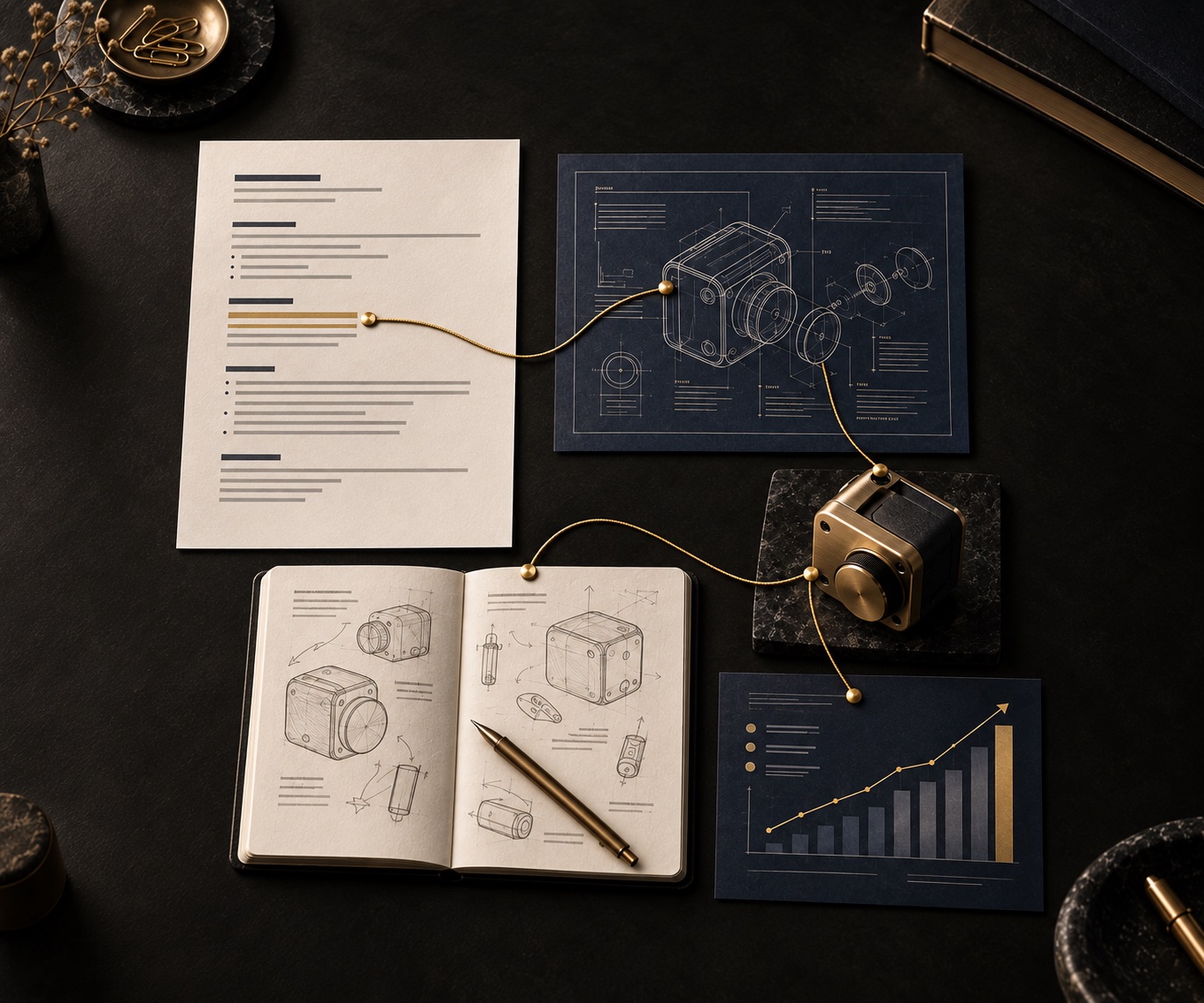

I have read résumés that say ‘led a migration’, ‘built a platform’ or ‘improved operations’. The statements may be completely true. The difficulty is that the most interesting part of the work has disappeared: what was broken, what choices were available, why one route was chosen, what the person actually made and where their judgment changed the result.
That is not a failure of writing. It is a consequence of the format. A résumé is built for compression. A portfolio can restore some of the depth that compression removes.
A résumé is a compression format
A useful résumé has hard limits. It must scan quickly, fit a role, survive an applicant-tracking system and give a reader enough signal to continue. Those constraints reward concise labels: role, company, period, responsibility, result. They do not leave much room for the chain of reasoning between a difficult starting point and a finished piece of work.
The same compression affects very different careers. An engineer writes ‘designed the data platform’ without the reliability constraint that shaped the design. A product leader writes ‘launched a new service’ without the customer evidence that changed the scope. A researcher lists a publication without showing how a model became an experiment. A founder says ‘built the team’ while the operating choices behind that work remain invisible.
The line can still be accurate. It simply cannot carry the whole story. Treating the résumé as the complete record encourages people to add stronger adjectives when what they really need is a second format.
Field signal/ 01A claim asks the reader to trust the conclusion. Evidence lets the reader examine how you arrived there.

A claim is not yet evidence
‘Owned the roadmap’ is a claim. A short account of the conflicting customer needs, the decision rule, the discarded options and the release that followed is evidence of product judgment. ‘Improved reliability’ is a claim. An incident pattern, a changed system boundary, a test strategy and the honest measurement window are evidence of engineering work.
Evidence does not have to mean publishing confidential files. It means making the structure of the work inspectable. Sensitive details can be removed. Numbers can be expressed as bounded ranges when permission is absent. A private system can be represented through a redrawn diagram, an anonymised decision record or a description of the constraint and method. The point is not exposure. It is specificity.
The best portfolio pieces usually answer four questions the résumé cannot: What was the context? Which decision was yours? What material trace did the work leave? What can you honestly say changed?
What useful evidence contains
A portfolio does not need a grand case study for every line of experience. It needs enough structure for a reader to distinguish participation from judgment. I look for five elements.
- Context: the system, customer, constraint or opportunity that made the work necessary.
- Responsibility: the part you actually owned, separated from the wider team effort.
- Decision: the alternatives, trade-offs and reasoning that reveal how you think.
- Artifact: a plan, model, prototype, interface, experiment, release note, operating document or other trace of the work.
- Boundary: the result, its measurement window, the limits of attribution and what remained unresolved.
The boundary matters as much as the result. ‘Reduced processing time by 30%’ sounds impressive, but a careful reader still wants to know what was measured, over what period and what else changed. If the evidence only supports ‘removed two manual reconciliation steps in the observed workflow’, say that. Precision is more credible than borrowed certainty.
Evidence is also broader than metrics. A research paper, a working prototype, a test harness, a before-and-after process, a customer interview synthesis, a migration plan, a training guide or a decision log can all reveal capability. Numbers are valuable when they are attributable. Material work is valuable because it shows the path.
One professional truth, shaped for different rooms
A résumé, portfolio, public profile and statement of purpose serve different readers. They should not become different identities. The résumé carries the compressed claim. The portfolio opens the evidence. The profile helps someone understand the through-line. A statement of purpose connects that through-line to a direction.
This is the idea behind Prime Portfolio: begin with a guided interview, synthesize role, focus, edge and selected evidence, then shape the same professional story for each format. The formats change. The underlying record does not.
The public Prime Portfolio example for Aarush Shah makes the distinction concrete. The résumé can list published bioluminescent photovoltaic research, propulsion work with the Purdue Space Program and Python modelling. The portfolio can go closer: it describes modelling low-light photovoltaic performance, building an experimental apparatus and comparing theoretical predictions with measured power output. The second form does not merely repeat the first. It shows how the work moved from equation to experiment.
On the live product, that same evidence is carried into an identity specification, a LinkedIn profile and a statement of purpose. Each artifact has a different job, but the research, models, prototypes and direction remain connected. That coherence is more useful than rewriting a person from scratch every time an opportunity changes.
Build the portfolio from work you already did
You do not need to wait for a perfect flagship project. Start with three pieces of work you can discuss responsibly. Choose moments that reveal different kinds of judgment: a hard decision, a crafted artifact and a result you can bound. Then reconstruct each one from the evidence outward.
First, collect the traces before writing the story. Find the diagram, prototype, calculation, annotated screen, experiment, planning note, release communication or public artifact. If the work is confidential, create a clean representation that preserves the method without reproducing protected material.
Second, write the decision, not the chronology. ‘We had six meetings, wrote requirements and shipped in June’ records activity. ‘We chose to separate the high-risk workflow because one shared release would have made rollback unsafe’ reveals judgment. The reader needs the hinge—the point where understanding changed what happened next.
Third, make your contribution legible without erasing the team. Say ‘I led the decision and wrote the migration plan; two engineers implemented the services’ when that is the truth. Specific collaboration is stronger than quietly claiming an entire system.
This is similar to translating a founder’s vision into a system: the task is not to decorate an idea, but to preserve its intent while making the decisions executable. The same discipline—context, boundaries and an explicit chain of reasoning—makes professional evidence understandable.
What a portfolio should not become
A portfolio is not a warehouse for everything you have touched. More projects can make the important work harder to find. It is not a gallery of polished screenshots with no explanation of the problem. It is not an autobiography, and it is not a place to turn a team result into an individual legend.
It should be edited. A senior professional may need only a handful of strong pieces. Each should earn its place by showing a capability the target reader needs to understand. The selection itself communicates judgment.
Good product strategy works the same way: decide what must be understood, remove what does not serve that understanding, and connect the evidence to the decision in front of the reader.
The résumé still matters
This is not an argument against résumés. The résumé is often the first useful map. It tells a recruiter, client, collaborator or admissions reader where to look. The problem begins when we expect that map to contain the landscape.
Use the résumé to make the claim clear. Use the portfolio to make the evidence available. Keep both connected to the same professional truth. When the reader wants to know not only what you did but how you think, there should be somewhere honest for them to go.
The strongest portfolio is not the one that makes every project look extraordinary. It is the one that makes real work—its constraints, choices, craft and limits—easy to see.
The goal is not to make a career look larger. It is to make the real work easier to see.
Dhaval ShahFounder & Principal Architect